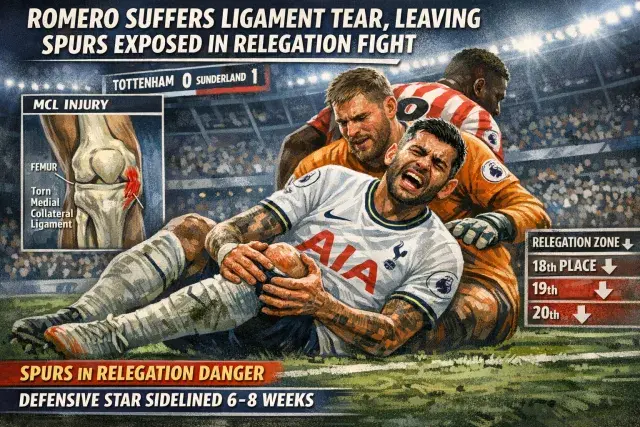
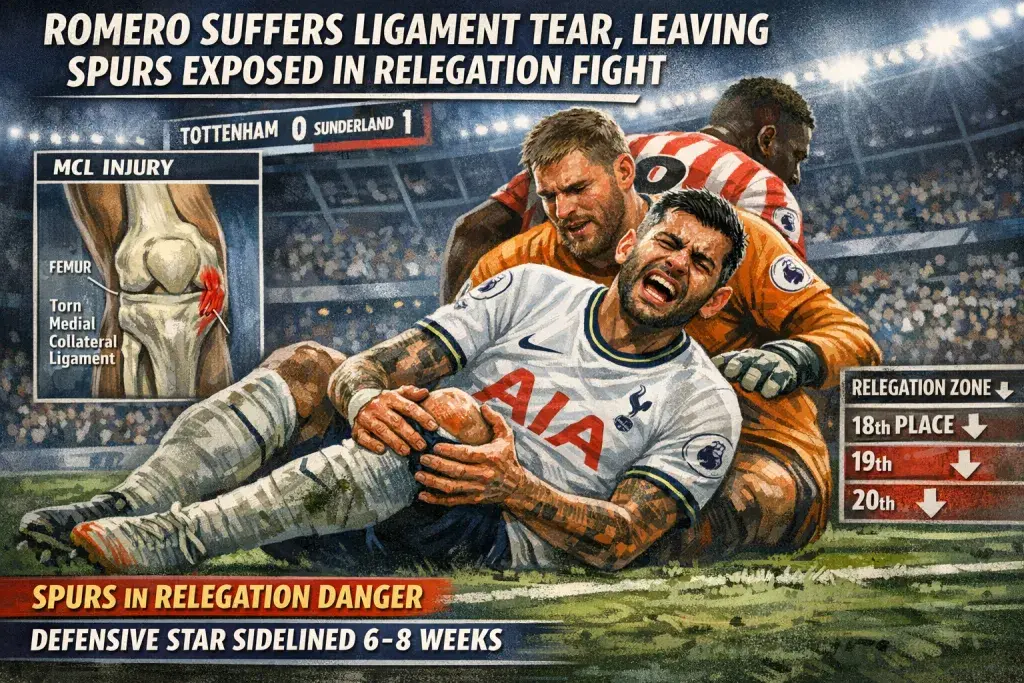
Cristian Romero has been diagnosed with a medial collateral ligament tear after sustaining the injury during Tottenham Hotspur's 1-0 home defeat to Sunderland, a result that deepens the club's already precarious position in the Premier League. The 27-year-old Argentine defender was hurt in the 70th minute when, pushed by Sunderland's Brian Brobbey, he collided awkwardly with goalkeeper Antonín Kinský and immediately clutched his knee. Scans confirmed the diagnosis, with the injury expected to sideline him for six to eight weeks — almost certainly ending his involvement with Spurs for the remainder of the current campaign.
The Anatomy of a Costly Injury
The medial collateral ligament, situated along the inner edge of the knee, is one of four principal stabilising structures in the joint. It connects the femur to the tibia and is primarily responsible for resisting forces applied to the outer knee — exactly the kind of stress generated when a player is pushed sideways and then absorbs secondary contact. MCL tears are graded on a scale of one to three: a Grade 1 involves microscopic damage with structural integrity largely intact, a Grade 2 represents a partial tear, and a Grade 3 is a complete rupture. Recovery timelines of six to eight weeks generally correspond to Grade 2 injuries, where conservative management — rest, physiotherapy, and controlled rehabilitation — is the standard course of treatment. Surgical intervention is rarely required for isolated MCL injuries at this severity.
What makes Romero's case medically instructive is the mechanism itself. The initial push off-balance compromised his lateral stability; the secondary collision with Kinský then forced his knee into a valgus position — inward collapse — under load. That compound sequence is precisely the scenario in which the MCL is most vulnerable. It is not a freak occurrence so much as a predictable consequence of the body's inability to absorb two destabilising forces in rapid succession.
A Club Stripped of Its Defensive Foundation
Romero's absence arrives at the worst conceivable moment for Tottenham. Currently 18th in the Premier League with six fixtures remaining, the club faces the very real prospect of relegation from the top flight for the first time in decades. Romero has been central to Spurs' defensive organisation throughout the season, and his physical presence — his capacity to win duels and impose himself on opposing forwards — is not easily replicated within the existing squad.
Their next fixture is an away visit to Brighton & Hove Albion, a side managed by Roberto De Zerbi, who took charge for the first time in this very fixture. Sunderland's winning goal arrived via an own goal, Nordi Mukiele's effort deflected in by Micky van de Ven — a cruel irony for a defence already under severe pressure. Without Romero, Spurs' backline will require significant reorganisation at precisely the point where cohesion and experience matter most.
World Cup Ambitions Still Within Reach
There is, at least from Romero's personal perspective, a degree of encouragement. The 2026 FIFA World Cup is scheduled to begin on 11 June, and a six-to-eight-week recovery window from the point of injury leaves a plausible, if tight, path to fitness. Argentina, the reigning world champions, will be expected to name Romero in their squad, and the medical timeline does not preclude participation — provided rehabilitation progresses without complication. MCL injuries at this grade do not typically produce lasting structural compromise once properly healed, and a return to full competitive intensity is a realistic expectation. Whether Romero can build sufficient match sharpness in the available window is the more pressing clinical question.
Racist Abuse and the Ongoing Failure of Online Accountability
Beyond the medical and competitive dimensions, the incident generated an uglier postscript. After Brobbey shared photographs from the fixture on social media, his posts were flooded with hateful and racist messages, a significant proportion originating from Argentina. Sunderland responded by reporting the abuse to police, to the relevant social media platforms, and to the Premier League. The episode is depressingly familiar. The infrastructure that allows content to be shared instantly across borders has consistently outpaced the mechanisms designed to moderate or police it — particularly when the targets are Black athletes and the abuse crosses international jurisdictions.
Sunderland's decision to escalate formally rather than issue a statement and move on is the correct one, even if the practical outcomes of such reporting remain limited. The Premier League has anti-discrimination commitments, but enforcement against anonymous or overseas accounts tests the boundaries of what any single governing body can achieve. What this incident reflects, once again, is a structural gap between the reach of digital communication and the reach of accountability — a gap that neither platforms nor governing bodies have yet found a credible way to close.